

When designing a piping system, choosing between a 45 degree elbow and a 90 degree elbow is a common decision engineers and buyers need to make. While both fittings are used to change the direction of flow, they perform differently in terms of pressure loss, flow efficiency, and installation space.
Understanding these differences can help you select the right pipe fitting for your project and avoid unnecessary performance issues.
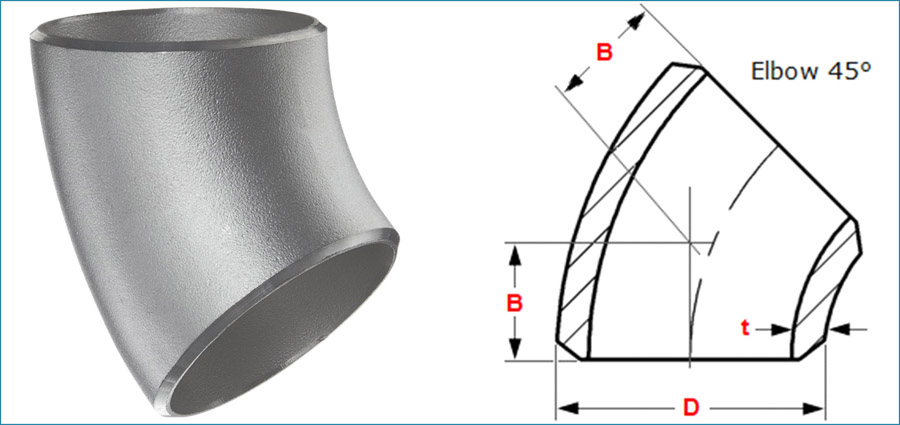
A 45 degree elbow is a pipe fitting that changes the direction of the pipeline by 45 degrees. It provides a smoother transition compared to sharper bends, which helps reduce turbulence and pressure drop.
Because of this, 45 degree elbows are often used in systems where maintaining steady flow and minimizing resistance is important.
👉 For a detailed product example and specifications, you can refer to:
www.senruipipe.com/products/asme-b16-9-45-degree-lr-elbow

A 90 degree elbow changes the direction of the pipe by 90 degrees. It is one of the most commonly used fittings in piping systems due to its ability to create a sharp turn in a limited space.
While it is highly practical, it generally creates more turbulence and pressure loss compared to a 45 degree elbow.
A 45 degree elbow allows a smoother change in direction, which reduces friction and turbulence.
A 90 degree elbow creates a sharper turn, which increases resistance in the system.
👉 If flow efficiency is critical, a 45 degree elbow is usually the better choice.
Pressure drop is lower in a 45 degree elbow because the flow path is less abrupt.
In contrast, a 90 degree elbow causes a higher pressure drop.
A 90 degree elbow is more compact and requires less space.
A 45 degree elbow may require more pipe length or even two elbows to achieve the same directional change.
45 degree elbows are commonly used in:
90 degree elbows are typically used in:
You should consider using a 45 degree elbow when:
A 90 degree elbow is more suitable when:
Both 45 degree and 90 degree elbows are available in a variety of materials and standards, including:
They are typically manufactured according to standards such as ASME B16.9.
There is no absolute “better” option between a 45 degree elbow and a 90 degree elbow. The right choice depends on your project requirements, including flow performance, pressure conditions, and available space.
In many industrial applications, engineers may even combine both types to achieve the best balance between efficiency and practicality.
If your priority is smoother flow and reduced pressure loss, a 45 degree elbow is often the better solution. If you need compact installation and quick direction changes, a 90 degree elbow is more practical.
Choosing the right pipe fitting is not just about function — it directly impacts the performance and reliability of your entire piping system.


